

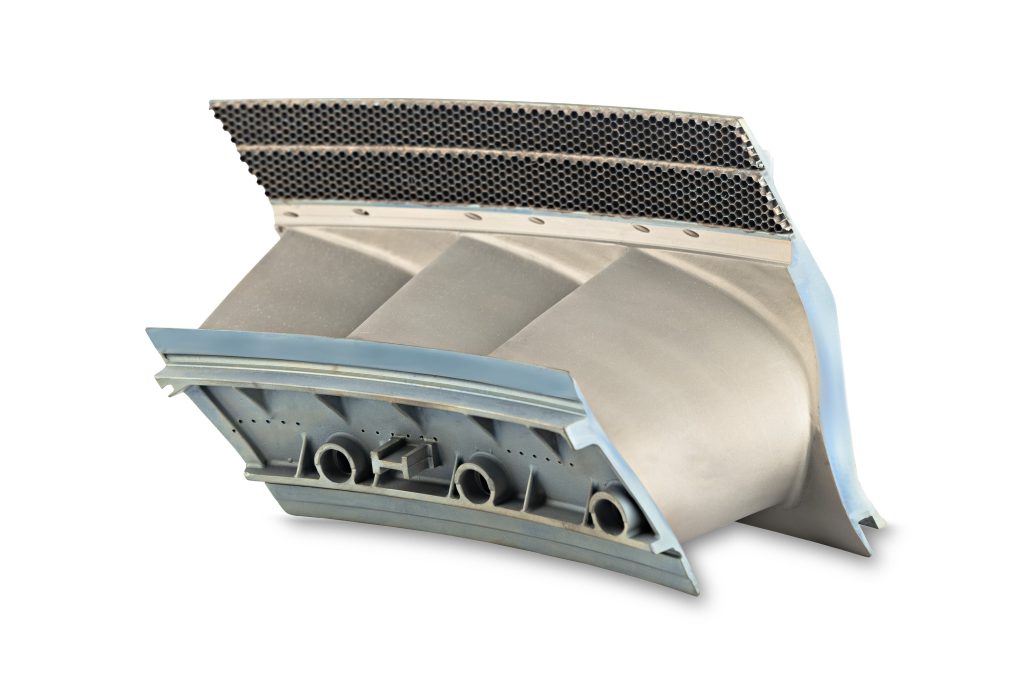
The main items include fixed and moving blades, sealing rings, glands and segments, stator segments, bearings, washers, lock washers, lock plates, gaskets, Nord-Lock, shims, orifices, spring washers, and so on. Of these, approximately 250 items are highly used during repair periods, while other items are used as needed on a case-by-case basis. Out of the total consumables for turbine repairs (about 800 items), the company orders spare parts annually for approximately 15 C-level and 5 B and C-level repair services, which generates a financial turnover of between 350 to 500 billion Toman for the company. Currently, more than 30 contractor companies are active and collaborating to supply spare parts for the manufacture and supply of various consumables under the Davvar Moharek brand. About 20% of these are foreign suppliers. Simultaneously, while sourcing and evaluating new contractors and suppliers for quantity and quality, the supplier network for the company’s spare parts is continuously monitored and developed. The close cooperation with companies such as Ghadir Yazd, Middle East Gas Turbines, Pars Precision Casting, Satk, and others within the Turbo Compressor Oil Group not only ensures quick order fulfillment for clients but also guarantees the quality of Davvar Moharek brand products

These materials are primarily used in the oil, gas, and petrochemical industries and require special expertise and attention due to their critical nature. With the company's technical and commercial potential in the field of chemicals, managing the supply of these materials generates an annual financial turnover of approximately 600 to 900 billion Toman for the company. Davvar Moharek has a structured plan for timely supply of spare parts and quality services to its clients' sites, based on the company’s internal guidelines and standards: Sourcing: Identifying and supplying materials and items needed for oil and gas operations, ensuring compliance with industry standards and regulations, and verifying the accuracy of documentation. Supply Chain Management: Managing logistics and supply chain to ensure timely delivery of goods to specified sites. Technical Support: Providing technical expertise and support to clients regarding proper use, handling, and application of supplied materials. Relationship Management: Maintaining strong relationships with clients, suppliers, and other stakeholders. Problem Solving: Addressing any issues related to supply chain, product quality, or delivery timelines promptly and effectively. Market Research: Staying informed about market trends, competitor activities, and technological advancements in related solutions. Regulatory Compliance: Adhering to environmental, safety, and health regulations to ensure compliance in all aspects of goods and services delivery. Quality Awareness: Ensuring that items and services provided meet customer safety regulations, quality standards, and formal requirements. Cost Management: Negotiating with suppliers on price and delivery terms to optimize costs while maintaining product quality standards. Documentation: Maintaining accurate records of inventory, shipments, and quality control documents to comply with regulatory requirements
Turbine Overhaul: Turbine repairs are categorized based on the operating hours of the equipment into maintenance levels A, B, C, D, and E. At each of these levels, inspections, replacements, and repairs are carried out according to the manufacturer's instructions. Preventive Maintenance: Daily, weekly, monthly, semi-annual, and annual maintenance. Minor Repairs: Small-scale repairs as needed. Overhaul of Turbo Compressors and Turbo Generators: Major repairs for turbo compressors, turbo generators, and station facilities. Unscheduled Repairs: Repairs required at gas pressure boosting stations and power plants. Turbine repairs are classified based on the operating hours of the equipment into levels A, B, C, D, and E. At each of these levels, inspections, replacements, or repairs are carried out according to the manufacturer's instructions. For example: Level A or 10,000-hour Maintenance: During this maintenance, the alignment of the turbine cases with the shaft is checked using a boroscope. If necessary, adjustments are made according to internal protocols. Level B or 20,000-hour Maintenance: In addition to the operations mentioned in the previous point, part GG is separated from PT, and the hot section of the motor in the CT area is also disassembled. The Vane1 assembly and combustion chamber are replaced, and the motor is reassembled. Level C or 40,000-hour Maintenance: In addition to the operations in points 1 and 2, Blade1 CT and Blade3 PT are also replaced, and the cold sections of the motor are inspected. NPT tests are also conducted in both the cold and hot sections of the motor

Providing alternative suggestions in material and engineering fields, including turbo generators and turbo compressors in refineries, power plants, and gas pressure boosting stations. Operating and controlling the performance of turbo compressors and turbo generators—reviewing the items and operational values of turbo compressors and turbo generators for starting or reconfiguring turbines. Coordinating with the Gas Dispatch Unit regarding turbo compressors and repairs related to the flow rate or output pressure of turbo compressors. Coordinating with the Ministry of Energy Dispatch for turbo generators in power plants and controlling the output megawatts of turbo generators. Providing additional dimensions or specifications to contractors if needed. Creating 3D models and new drawings or making modifications to existing drawings and models as required. Offering consulting services regarding the improvement of technical and operational processes to operations and maintenance units